syn. Heliotropium humifusum Kunth
Matlike
Heliotrope
Family: BORAGINACEAE
Cayman Islands, Cuba and Hispaniola
It was found by Wilfred Kings on the 1938 Oxford University Expedition to the Cayman Islands, on Grand Cayman and Little Cayman, and by George R. Proctor on Cayman Brac (1992).Family: BORAGINACEAE
Cayman Islands, Cuba and Hispaniola
FLORA of the CAYMAN ISLANDS by George R. Proctor
p.563, Plate 53
Heliotropium humifusum Kunth in H.B.K.,
Nov. Gen. & Sp. 3:85, t. 205. 1818.
Cayman
Islands Red List status: Data deficient, suspected to be at risk

Matlike Heliotrope at Watler Cemetery, May 11, 2014
A
dense, matlike, suffrutescent shrub, diffusely branched, clothed throughout
with stiff white strigose hairs mostly with pustulate bases.
LEAVES:
densely overlapping, rigid, lance-oblong, acute at the apex and 1-nerved,
attached to the stem by a broad base.
FLOWERS:
Calyx strigose, 2–3 mm long; corolla white with yellow eye, the tube scarcely
exceeding the calyx, the expanded limb 2–3 mm across or more. Stigma capitate
on a short style.
FRUIT:
subglobose, enclosed by the calyx, the nutlets hispidulous.
Proctor’s
FLORA Glossary p.694:
Strigose – bearing appressed, sharp, straight, stiff hairs.
Strigose – bearing appressed, sharp, straight, stiff hairs.
Suffrutescent
– a stem which is woody and perennial at the base, but has a upper herbaceous
portion that dies back at the end of a growing season. The term is also used
to mean ‘slightly shrubby’.
GRAND CAYMAN: Crosby, Hespenheide & Anderson 37 (GH, MICH): Kings GC 59, GC 123; Proctor 15159, 52241; Sauer 4214 (WIS).
LITTLE CAYMAN: Kings LC 48, LC 78; Proctor 28129, 35137.
CAYMAN BRAC: Proctor 35154
Cuba and Hispaniola, usually in gravel-filled pockets of dry, exposed limestone, or in sandy clearings. Cuban plants of this affinity growing on serpentine appear to represent a different species, though usually identified as being the same.
Crosby, Hespenheide and Anderson, June 2, 1963
June 2, 1963 #37. East of George Town in sand behind beach. Locally common. Flowers white with yellow centers; growing completely recumbent in sand.
M. R. Crosby, H. A. Hespenheide, W. R. Anderson, det C.D. Adams 1963.
Robert K. Godfrey Herbarium at Florida State University.


Matlike Heliotropes at the Watler Cemetery, Prospect Point, Grand Cayman,June 24, 2012
CaymANNature Flora IMAGES
CaymANNature Flora IMAGES

May 9, 2014 Brenda Quin's plant, Parsons Circle, George Town, Grand Cayman

May 11, 2014 Watler Cemetery, Prospect Point, Grand Cayman
About
ten years ago, Brenda Quin saw lots Heliotropium humifusum plants growing in
a dry area in the vicinity of the Blow Holes, on the landward side of the main
road (south coast). She described it as a ground cover with minute, white,
star-shaped flowers. She tried growing one in a pot, but it didn’t take. A palm
tree grew in the same pot.
A year ago she transplanted the root-bound palm tree into a larger pot. In early May, 2014, the little ground cover emerged from a seed or root that had been dormant in the soil for about ten years.
A year ago she transplanted the root-bound palm tree into a larger pot. In early May, 2014, the little ground cover emerged from a seed or root that had been dormant in the soil for about ten years.

May 9, 2014 Brenda Quin's Matlike Heliotrope - Heliotropium humifusum
that had been dormant for about 10 years
that had been dormant for about 10 years

Brenda Quin, 86 years old, with her little Matlike Heliotrope that had been dormant for about 10 years,
in pot with palm tree. George Town, Grand Cayman, May 9, 2014
in pot with palm tree. George Town, Grand Cayman, May 9, 2014

A few tiny plants flowering by the house-shaped grave-markers at the Watler Cemetery, May 11, 2014.
CaymanCultural images
 Matlike Heliotrope - Heliotropium humifusum habitat -
Pedro St. James bluff, Grand Cayman,
many little plants in flower, growing on the harsh, ironshore environment, May 28, 2015.
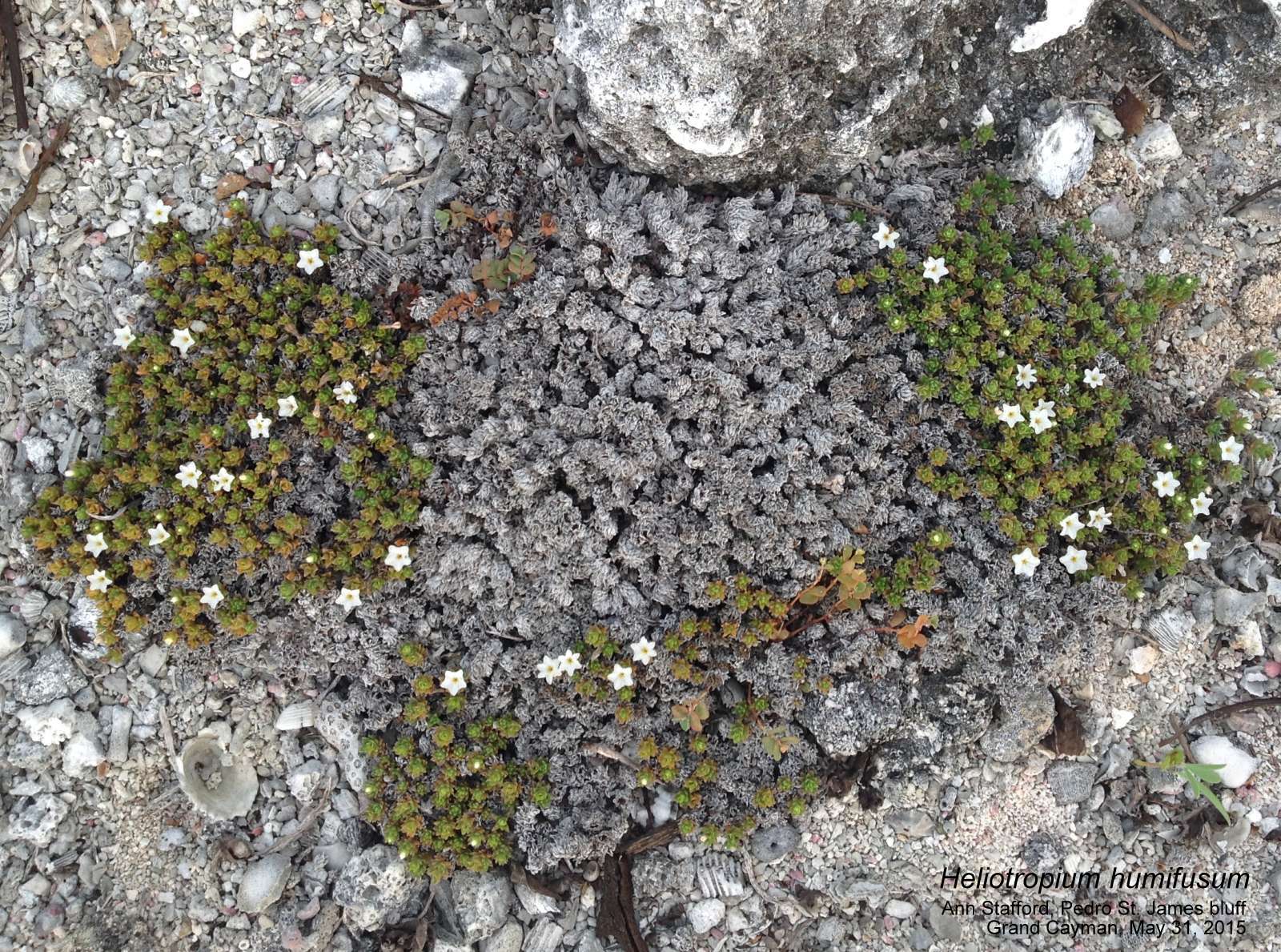
 Matlike Heliotrope - Heliotropium humifusum,
Pedro St. James bluff, Grand Cayman, May 31, 2015.
 Matlike Heliotrope - Heliotropium humifusum,
plant dries to grey so is well-camouflaged against the ironshore.
Pedro St. James bluff, Grand Cayman, May 31, 2015.
 Ironshore plants - young Silver Thatch (Coccothrinax proctorii),
Juniper (Rhachicallis america), Seaside Twintip (Stemodia maritima) and
Matlike Heliotrope in the centre.
The rust-coloured rock is consolidated Terra Rosa that had been swept into cavities in the rock formation.
Islands from the Sea, Geologic Stories of Cayman
by Murray A. Roed, 2006
 Lots of little compact Matlike Heliotrope (Heliotropium humifusum)
plants that dry to grey, well-camouflaged against the flattened ironshore.
Pedro St. James bluff, Grand Cayman, May 31, 2015.
 Looking across Old Jones Bay to Pedro St. James bluff,
harsh environment of Heliotropium humifusum, May 31, 2015.
1938 Oxford University Biological Expedition to the Cayman Islands


Pedro St. James bluff, Grand Cayman,
many little plants in flower, growing on the harsh, ironshore environment, May 28, 2015.

Pedro St. James bluff, Grand Cayman, May 31, 2015.
plant dries to grey so is well-camouflaged against the ironshore.
Pedro St. James bluff, Grand Cayman, May 31, 2015.

Juniper (Rhachicallis america), Seaside Twintip (Stemodia maritima) and
Matlike Heliotrope in the centre.
The rust-coloured rock is consolidated Terra Rosa that had been swept into cavities in the rock formation.
Islands from the Sea, Geologic Stories of Cayman
by Murray A. Roed, 2006

plants that dry to grey, well-camouflaged against the flattened ironshore.
Pedro St. James bluff, Grand Cayman, May 31, 2015.

harsh environment of Heliotropium humifusum, May 31, 2015.
1938 Oxford University Biological Expedition to the Cayman Islands
Euploca ternata (Vahl) J.I.M. Melo & Semir
Euploca ternata (Accepted name)
= Heliotropium
ternatum
Vahl, Symb. Bot. 3:21. 1794. (synonym)
Bushy Heliotrope
FLORA of the CAYMAN ISLANDS by George R. Proctor
p.563, Fig.209
Cayman Islands Red List status: Data deficient
Cayman Islands Red List status: Data deficient
Bushy Heliotrope - Heliotropium ternatum, High Rock, Grand Cayman
Ann Stafford, Feb. 3, 2008
Ann Stafford, Feb. 3, 2008
A
mostly erect, bushy shrub up to 1.5 m tall, densely white-pubescent throughout.
LEAVES
rigid, alternate, opposite or in whorls of 3, sharply acute at the apex, the
hairs on the upper side with pustulate bases, the margin usually revolute.
FLOWERS
few in short terminal spikes; calyx 3–4 mm long, white-strigose; corolla white
with yellow eye, the tube 4 mm long, the expanded limb mostly 3–4 mm across.
NUTLETS
subglobose, black.
GRAND
CAYMAN: Brunt 2007. 2199; Proctor 15195.
West
Indies and continental tropical America,
in dry sandy or rocky thickets.

Bushy Heliotrope - Heliotropium ternatum, East End, Grand Cayman
Ann Stafford, Aug. 8, 2010
Ann Stafford, Aug. 8, 2010
Coral/limestone ridge bordering the sea, Half Moon Bay, June 13, 1967
Heliotropium ternatum (Dominica)
July 18, 1964 R. L. Wilbur, E. L. Dunn, H. A. Hespenheide, D. R. Wiseman
July 18, 1964 R. L. Wilbur, E. L. Dunn, H. A. Hespenheide, D. R. Wiseman


